
September 17, 2026
"They will regulate things that are not visible to any neighbor, anybody, and they can't see," homeowner Jim Sheriff told a Los Angeles television station earlier this year, describing his fight with the board that controls what he can do to the outside of his own house. Another owner in the same report faced more than $10,000 in penalties for exterior changes made before he ever bought the place. Neither man was talking about the City of Palos Verdes Estates. They were talking about the Art Jury, a private board that has been approving and rejecting exterior changes here since 1923, sixteen years before the city itself existed.
If you are comparing Palos Verdes Estates to Rancho Palos Verdes or Rolling Hills Estates right now, you have probably already read that PVE has stricter architectural standards. What most comparisons skip is the mechanism, and the mechanism is the actual story. This is the one Peninsula city with no municipal view ordinance at all. Instead of a city law, a private homeowners association enforces deed restrictions that run with the land, and that difference shapes everything from your remodel timeline to whether your escrow closes on schedule.
Rancho Palos Verdes has Proposition M, codified as Section 17.02.040, which caps foliage at 16 feet or a neighbor's ridgeline, whichever is lower, and ties a protected view to a 1989 baseline that transfers to every buyer who closes escrow. Rolling Hills Estates runs a different system entirely, anchoring the baseline to when you personally bought your home and defining a protected view narrowly, as tested in a court case over whether a garden view even qualifies. Both cities regulate trees and views through a municipal ordinance you can look up.
Palos Verdes Estates has no equivalent. There is no city view law to file a complaint under, no ordinance number to cite if a neighbor's hedge grows past your sightline. The city does have a separate process called the Neighborhood Compatibility Ordinance, which lets neighbors weigh in on a project's size and height at a public hearing with a right of appeal to the City Council, but that is a land use tool, not a view law, and it is administered entirely apart from the board that actually controls what your house looks like.
That board is the Palos Verdes Homes Association, and its enforcement arm is the Art Jury.
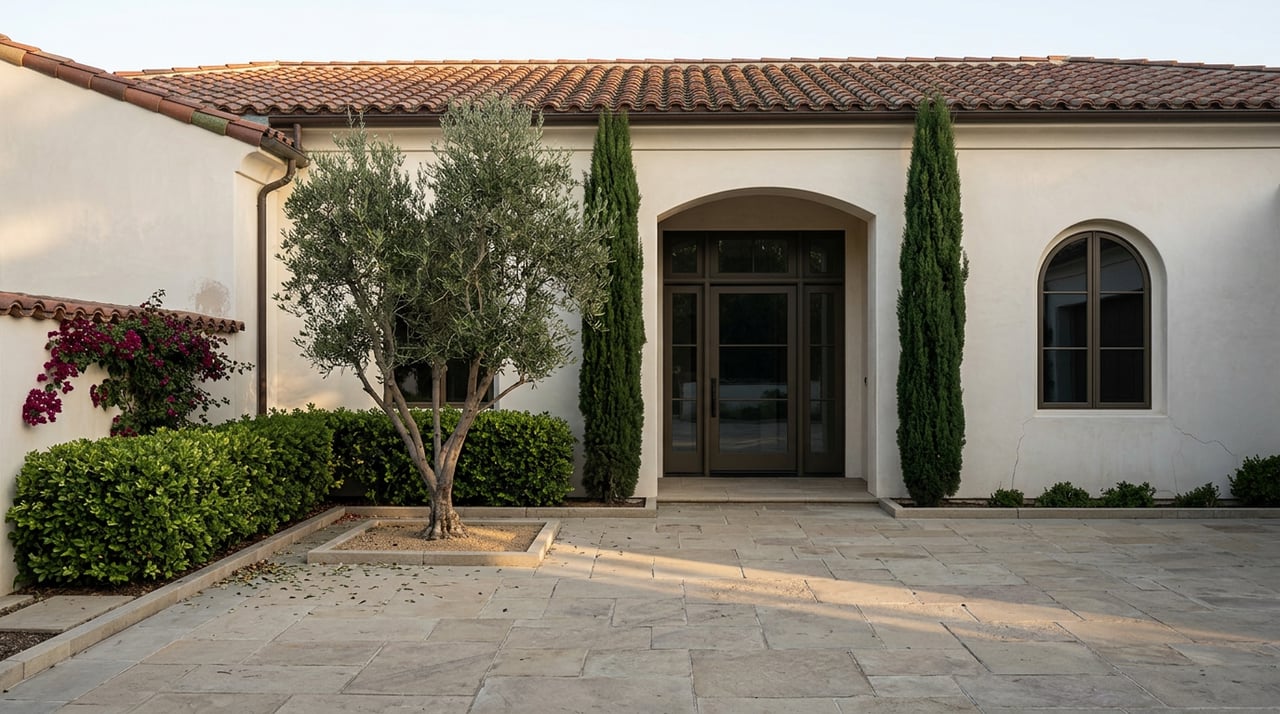
The Art Jury traces back to 1923, when the original Palos Verdes Project recorded Protective Restrictions against the land itself. Architect Myron Hunt, who designed the Malaga Cove Library, was among the founders who used that authority to set the Spanish and Mediterranean architectural standard the Peninsula is still known for. Palos Verdes Estates was not incorporated as a city until 1939, sixteen years later. The Homes Association and its Art Jury today hold jurisdiction over roughly 5,500 properties across all of Palos Verdes Estates and the Miraleste neighborhood inside Rancho Palos Verdes, a footprint that predates and outlasts city boundaries.
Because the restrictions are deed restrictions, not city code, they attach automatically to every subsequent owner. You do not sign anything to be bound by them. You just buy the house.
That single fact is why the process feels different from a normal city permit. A city ordinance has a public record you can search and, at least in theory, an argument about how long the city waited to enforce it. A deed restriction recorded against the land carries no such expiration. If a prior owner reroofed, repainted, added a skylight, or replanted a front yard without Art Jury sign-off, that non-compliance does not age out. It waits for the next buyer, or more precisely, for that buyer's lender or insurer to find it during underwriting.
Most home sales in Los Angeles County run on a single paper trail: permits pulled with the city, closed out with final inspections. Palos Verdes Estates runs two, in parallel, from different offices, and only one of them is the one most buyers' agents think to request.
The first is the standard one, the kind of report a buyer's agent orders as routine due diligence on any California property. The second is a Completion and Compliance file specific to the Art Jury, and it only gets ordered when a seller actually asks for it, typically right before listing. The Homes Association's own guidance to prospective buyers is direct on this point: absent a Completion and Compliance inspection, a new owner assumes all non-compliant conditions on the property and the obligation to correct them.
That is the gap that catches people off guard. A buyer or their agent can pull a clean standard report and still be looking at a house carrying an unresolved Art Jury violation nobody flagged, because nobody asked the second question.
Fees for Art Jury review run from roughly $1,000 to $15,000 depending on project scope, charged separately from whatever the city charges for its own permit. Timelines follow a similar split. A simple submittal, a paint color change or a straightforward repair, can clear in two to eight weeks. A second story, a new home, or significant grading can take three to nine months and multiple rounds of review, running alongside, not instead of, the city's own building plan check. Unpermitted or unapproved exterior work can stall a closing outright: lenders and insurers ask for proof of both approvals, and a seller without them may be asked to pull retroactive permits or undo the work before the deal moves forward.
| Reviews the exterior look | Reviews the structure and land use |
|---|---|
| Art Jury (Palos Verdes Homes Association) | City of Palos Verdes Estates Planning & Building |
| Colors, materials, rooflines, landscaping visible from the street | Zoning, setbacks, lot coverage, grading, safety code |
| Authority from 1923 deed restrictions | Authority from municipal ordinance |
| Fees run roughly $1,000 to $15,000 by project size | Separate city permit and plan check fees apply |
Market trackers do not agree on a single number for Palos Verdes Estates right now, and the disagreement itself is informative. Depending on the window measured, recent medians have landed anywhere from roughly $2.4 million to $3.0 million. What the trackers do agree on is the shape of the year: homes were sitting on the market close to 99 days in February 2026 with nearly 7.4 months of supply and a sale-to-list ratio of 97.69%, the kind of reading that hands buyers negotiating room. By the three-month window ending in May 2026, the average had tightened to 43 days, though that was still slower than the 32-day average the same window showed a year earlier. Then, by July 2026, sales volume itself had thinned, with 17 homes closing compared with 24 in July 2025, even as the sale-to-list ratio climbed back to 98.9% and the median for that month rose to $2.73 million from $2.44 million a year prior.
A market moving through swings like that is not one where a seller can afford an unplanned delay. A listing that opens with a current standard report, a Completion and Compliance letter already in hand, and Art Jury approvals filed for every visible change closes on the timeline the market supports. A listing that opens without those documents closes whenever the paperwork catches up, and this year has already shown how much that timeline can move within a matter of months.
The city's own utility undergrounding program illustrates the same theme from a different angle. Palos Verdes Estates supports neighborhood-driven projects to bury overhead lines, either privately financed between property owners and utility companies or formed as an assessment district, which requires at least five parcels, 600 linear feet of line, and signatures from 60% of affected owners before the city will help finance the work. The city has confirmed that a current fiber buildout in Lunada Bay is the first phase of a larger citywide rollout, with other neighborhoods to follow as the utility prioritizes areas that still have aerial lines. Even a resident-led undergrounding project still has to submit its design for city review before construction begins.
Nothing exterior in Palos Verdes Estates moves without leaving a paper trail somewhere. That is true whether the change is a repainted facade, a new roofline, or a utility pole coming out of the ground.
If you are selling here, request your Completion and Compliance file well before your listing photos are scheduled, not after an offer is already in hand. Gather Art Jury approval letters and city permits for any exterior work done during your ownership, and ask a prior owner's paperwork trail be part of your own file if you inherited unresolved items. If you are buying, ask your agent to request both files during your inspection period, not just the standard report, and budget real time, not just money, for any exterior change you plan to make once you own the house.
Does Palos Verdes Estates have any view protection at all? Not through a city ordinance. Views are addressed indirectly, through the Art Jury's design review and the city's separate Neighborhood Compatibility process, neither of which functions as a formal view law the way Rancho Palos Verdes or Rolling Hills Estates ordinances do.
Do I need Art Jury approval for something as small as a paint color? Generally yes, if the change is visible from the street or a neighboring property. Simple submittals typically move in two to eight weeks.
Can Art Jury non-compliance actually stop a sale? It can slow one down significantly. Lenders and insurers may flag unpermitted exterior work, and buyers frequently request proof of both city and Art Jury approval before closing.
Understanding which board actually controls your house, and which file proves you are square with it, is the kind of detail that only shows up when you have handled Peninsula transactions before. Adela Randazzo and her team work these compliance questions into every Palos Verdes Estates listing from day one, so nothing surfaces late in escrow. Request Your Free Home Valuation to start that conversation before you list.


What Fall Home Buying Actually Looks Like on the Palos Verdes Peninsula.
A Realistic Look at Palos Verdes Peninsula Home Affordability.
Experience a team dedicated to your success—offering expert guidance, proven market strategies, and a seamless real estate journey from start to finish.
Randazzo Real Estate
(424) 400-8970
[email protected]
Adela Randazzo | CA DRE# 01954846
28901 S Western Ave Ste #107
Rancho Palos Verdes CA 90275